

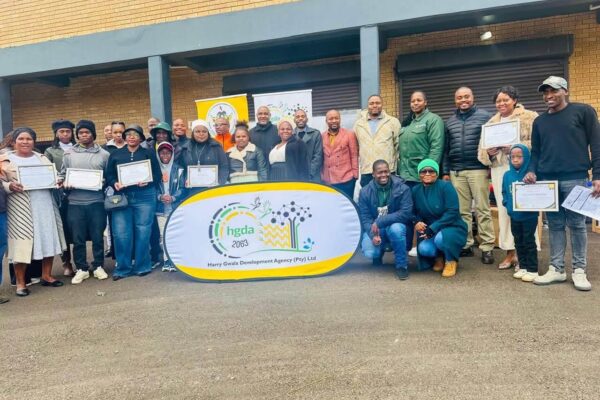
A group of determined farmers behind the Goxe Agri-Tourism Project are working hard to turn land reform into real economic opportunity by producing crops, raising livestock and supplying food to their community.
The farm, which spans approximately 640 hectares, was acquired through the government’s land reform programme. According to members of the cooperative, the initiative gave them an opportunity to access land and improve their livelihoods through agriculture. “We got this farm through the land reform programme. The government helped us access the land so we can farm and improve our lives,” the cooperative explained.
The farm is operated by a legally registered cooperative consisting of five members. In addition to the core members, the project also provides employment to 11 casual workers who assist with planting and harvesting activities during busy farming seasons. Members say their decision to enter the farming sector was driven by a desire to create employment, support their families and contribute to local food production. “We started farming because we wanted to create jobs, support our families, and produce food for the community,” they said. “Some of us grew up helping our parents with farming at home, so we already had some experience, and we have continued learning through training and practice.”
The cooperative produces both crops and livestock. Their main crops include maize and a variety of vegetables, while the livestock component consists of cattle and goats. The land is used for both crop production and grazing, allowing the cooperative to diversify its agricultural activities. Vegetables produced on the farm are also sold directly to members of the local community, helping to ensure access to fresh produce while generating income for the project. The farm generates revenue mainly through the sale of crops and livestock to local markets, community members and small businesses. However, running the farm also comes with significant expenses, including the purchase of seeds, fertilizer, animal feed, transport costs, equipment repairs and wages for workers.
Despite these costs and other challenges such as unpredictable weather, the cooperative managed to record a small profit last year. “We did make a small profit last year, even though it was difficult because of the high input costs and weather conditions,” the cooperative said. In terms of market access, the cooperative currently sells most of its produce directly to customers. Their buyers include community members, informal markets, street vendors, small businesses and schools that rely on local suppliers.
The project has also begun forming partnerships with larger buyers. The cooperative currently has a contract with Boxer to supply produce and hopes to secure another agreement with Spargs Wholesale once their vegetables are harvested. In addition, the cooperative has an investment contract with PSP for maize production. Members believe there is significant room for growth if the farm receives the necessary support. They say there are opportunities to supply schools, supermarkets and government feeding schemes if production capacity can be increased.
However, several challenges continue to slow the project’s expansion. Among the major difficulties are water shortages, poor irrigation infrastructure and the high cost of farming inputs such as feed, fertilizer and chemicals. The cooperative also lacks a proper dipping tank and cattle handling race, which are essential for managing livestock health and safety. Limited funding is another major obstacle preventing the cooperative from expanding operations and creating more jobs in the community.
To overcome these challenges, the cooperative is calling for greater post-settlement support, including financial assistance, improved irrigation systems, training in modern farming methods and regular visits from agricultural extension officers. Members also highlighted the need for storage facilities, stronger security and access to larger, more stable markets. With the right support and investment, the Goxe Agri-Tourism Cooperative believes the farm can grow into a sustainable agricultural enterprise that not only feeds communities but also creates jobs and economic opportunities in the area.